What is Micro-TESE?
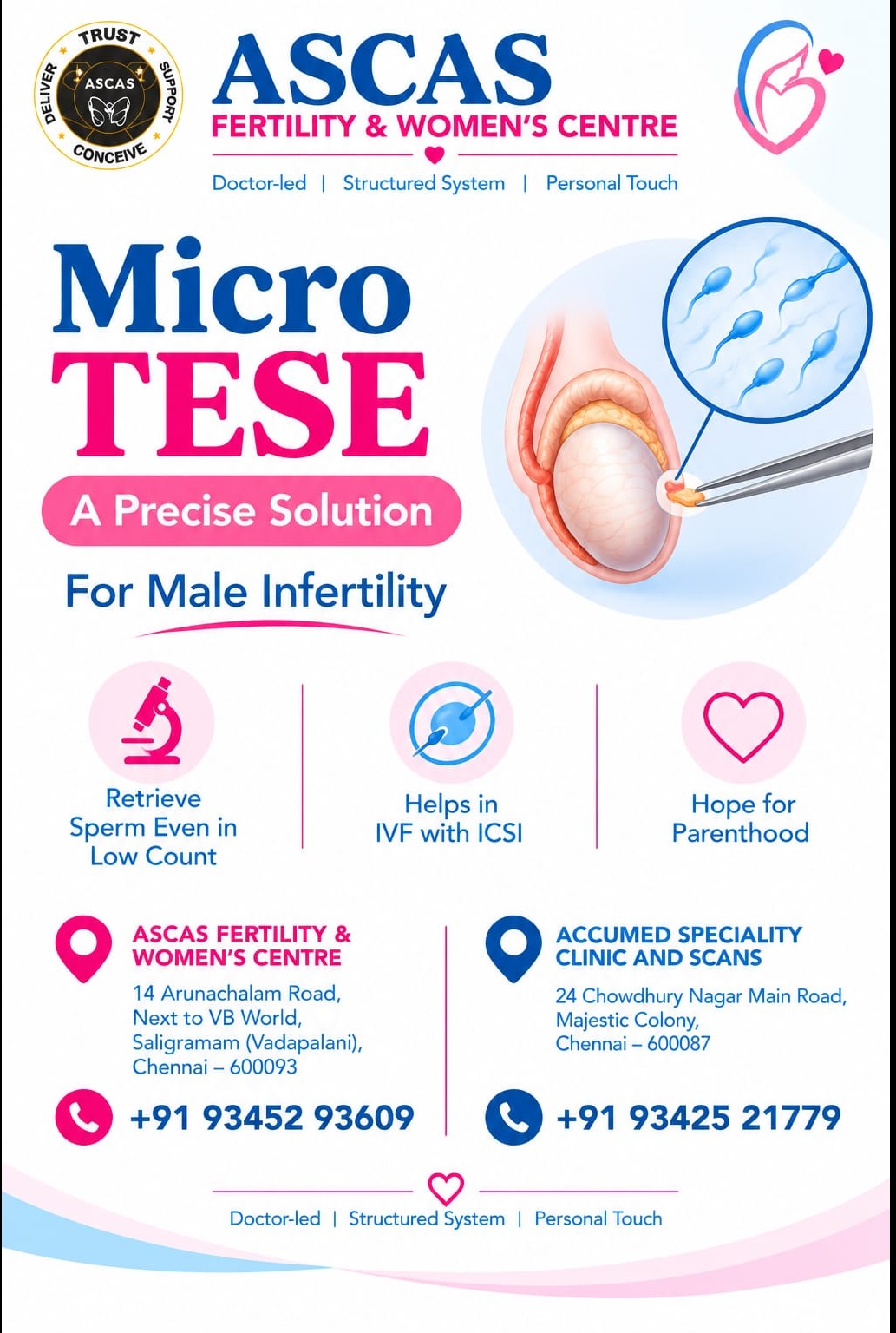
Micro-TESE stands for Microsurgical Testicular Sperm Extraction. It is a specialised surgical procedure used to retrieve sperm directly from the testicular tissue.
It is mainly considered for men with non-obstructive azoospermia (NOA), a condition in which no sperm are found in the ejaculate because sperm production is severely reduced or impaired.
Who may benefit from Micro-TESE?
Micro-TESE may be considered for selected men with:
*Non-obstructive azoospermia (NOA): No sperm found in the semen due to impaired sperm production.
*Severely impaired sperm production: Sperm may be present only in small, localised areas of the testicular tissue.
*Previous unsuccessful sperm retrieval: Selected patients may be assessed for repeat or salvage Micro-TESE.
*Certain testicular conditions: Including selected cases of Klinefelter syndrome, following specialist evaluation.
*Micro-TESE is not required for every man with a low sperm count. Men with obstructive azoospermia may need a different sperm retrieval technique.
How is the Micro-TESE procedure performed?
The procedure is carried out by a trained surgeon, generally under anaesthesia.
1.Pre-procedure evaluation: Medical history, repeated semen analysis, hormonal tests and relevant genetic investigations are reviewed.
2.Surgical access: A small incision is made to access the testis.
3.Microscopic examination: An operating microscope helps the surgeon identify seminiferous tubules that may contain sperm.
4.Tissue collection: Selected tubules are carefully sampled while aiming to preserve healthy testicular tissue.
5.Laboratory examination: The collected tissue is examined by an embryology laboratory to identify sperm.
6.Sperm preservation or use: Retrieved sperm may be used for ICSI or frozen for future treatment when suitable.
Benefits of Micro-TESE
*Helps identify sperm in selected men with non-obstructive azoospermia.
*Uses magnification to guide targeted tissue sampling.
*Aims to retrieve sperm while limiting unnecessary tissue removal.
*Retrieved sperm may be used for IVF with ICSI.
*May provide an opportunity for biological parenthood in suitable cases.
What happens after sperm retrieval?
If sperm are successfully retrieved, the fertility team may recommend:
*ICSI (Intracytoplasmic Sperm Injection): A selected sperm is injected directly into an egg.
*Embryo development: Fertilised eggs are monitored in the laboratory.
*Embryo transfer: A suitable embryo may be transferred into the uterus.
*Sperm freezing: Retrieved sperm may be cryopreserved for future use when the quantity and quality allow.
Risks and recovery
Micro-TESE is a specialised surgical procedure. Like other surgeries, it has possible risks, including:
*Pain, swelling or bruising.
*Bleeding or infection.
*Anaesthesia-related complications.
*Temporary or, rarely, persistent reduction in testosterone levels.
*Failure to retrieve sperm.
Recovery varies between individuals. Patients are generally advised to follow the surgeon's instructions, avoid strenuous activity during the initial recovery period and attend follow-up appointments.
How ASCAS supports your fertility journey
At ASCAS Fertility & Women’s Centre, Vadapalani, Chennai, we believe male fertility evaluation is an important part of comprehensive fertility care.
Dr. Aishwarya Parthasarathy – Consultant Fertility Specialist & Gynaecologist guides couples through fertility evaluation and discusses suitable assisted reproductive options.
The clinical team helps coordinate investigations and treatment planning.
The embryology team plays an important role in identifying, handling and preserving retrieved sperm.
ASCAS Fertility & Women’s Centre
14 Arunachalam Road, Next to VB World, Saligramam (Vadapalani), Chennai – 600093
Phone: +91 93452 93609
Accumed Speciality Clinic & Scans
24 Chowdhury Nagar Main Road, Majestic Colony, Chennai – 600087
Phone: +91 93425 21779
ASCAS Fertility & Women’s Centre
Doctor-led • Structured System • Personal Touch
Keywords