What is Low AMH?
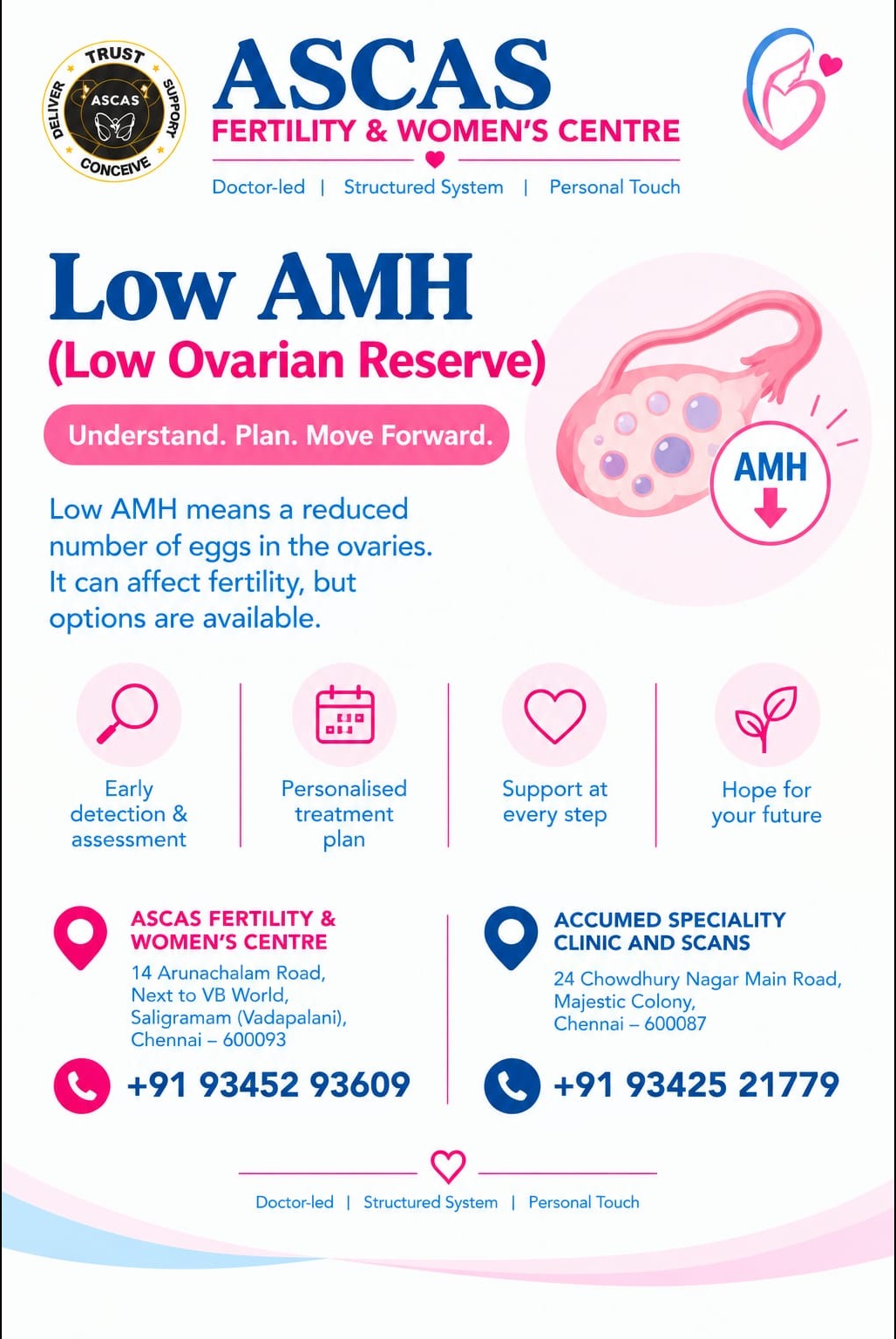
Anti-Müllerian Hormone (AMH) is a hormone produced by small developing follicles in the ovaries. An AMH blood test helps estimate a woman’s ovarian reserve, which refers to the remaining quantity of eggs in the ovaries.
A low AMH level may indicate a reduced ovarian reserve and can help fertility specialists estimate how the ovaries might respond to fertility treatment. However, low AMH does not automatically mean infertility or that natural pregnancy is impossible.
AMH is only one part of a fertility assessment. Age, menstrual history, ultrasound findings and other clinical factors are also important.
What can low AMH mean for fertility?
Low AMH may be associated with:
*A lower number of eggs available for stimulation during IVF.
*A reduced response to ovarian stimulation medicines.
The need for careful planning when considering fertility treatment.
*The importance of discussing fertility goals and timing with a specialist.
*Low AMH alone cannot reliably predict whether or when natural conception will occur, and it does not directly measure egg quality. Age remains an important factor in egg quality and reproductive outcomes.
Common causes and risk factors
Low AMH may be associated with:
*Increasing age and the natural decline in ovarian reserve.
*A family history of early menopause or reduced ovarian reserve.
*Previous ovarian surgery or certain ovarian conditions.
*Chemotherapy or radiotherapy that may affect ovarian function.
*Certain genetic or medical conditions.
*Sometimes, the exact cause is not identifiable. A low result should always be interpreted alongside your medical history and other investigations.
How is Low AMH evaluated?
At ASCAS Fertility & Women’s Centre, fertility assessment may include:
*AMH blood test: Helps assess ovarian reserve.
*Antral Follicle Count (AFC): An ultrasound assessment of small follicles in the ovaries.
*Hormonal evaluation: Additional tests such as FSH and estradiol, when clinically appropriate.
*Fertility history: Review of age, menstrual cycles, previous treatments and pregnancy history.
*Personalised consultation: Discussion of fertility goals and suitable next steps.
*The tests recommended depend on each patient's individual circumstances.
Treatment options for Low AMH
Low AMH cannot usually be corrected simply by taking a supplement or medication. Treatment focuses on understanding ovarian reserve and choosing an appropriate fertility plan.
Depending on the assessment, options may include:
Natural conception planning: May be appropriate for some patients, depending on age and other fertility factors.
*Ovulation monitoring: Helps assess follicular development and plan treatment when indicated.
*Ovulation induction: Medication may be considered in selected patients.
*IUI (Intrauterine Insemination): May be suitable in selected cases, depending on the overall fertility assessment.
*IVF (In Vitro Fertilisation): May be considered based on age, ovarian reserve, diagnosis and reproductive goals.
*Fertility preservation: Egg or embryo freezing may be discussed when appropriate, taking age and individual circumstances into account.
*Low AMH does not automatically mean IVF is necessary, and treatment success cannot be predicted from AMH alone.
Benefits of early fertility assessment
*Better understanding of ovarian reserve.
*Timely discussion of fertility goals.
*More informed decisions about treatment options.
*Personalised planning based on age and medical history.
*Opportunity to discuss fertility preservation when appropriate.
*Remember: Early assessment helps with planning, but no single test can guarantee future fertility.
How ASCAS supports your fertility journey
At ASCAS Fertility & Women’s Centre, Vadapalani, Chennai, fertility care is guided by an individualised approach.
Dr. Aishwarya Parthasarathy – Consultant Fertility Specialist & Gynaecologist helps patients understand their reports, evaluate
fertility concerns and discuss suitable options.
*The clinical team supports investigations, treatment coordination and follow-up.
*Patients receive guidance to make informed decisions based on their medical needs and personal goals.
*Our approach combines doctor-led care, a structured system and a personal touch throughout the fertility journey.
ASCAS Fertility & Women’s Centre
14 Arunachalam Road, Next to VB World, Saligramam (Vadapalani), Chennai – 600093
Phone: +91 93452 93609
Accumed Speciality Clinic & Scans
24 Chowdhury Nagar Main Road, Majestic Colony, Chennai – 600087
Phone: +91 93425 21779
ASCAS Fertility & Women’s Centre
Doctor-led • Structured System • Personal Touch
Keywords