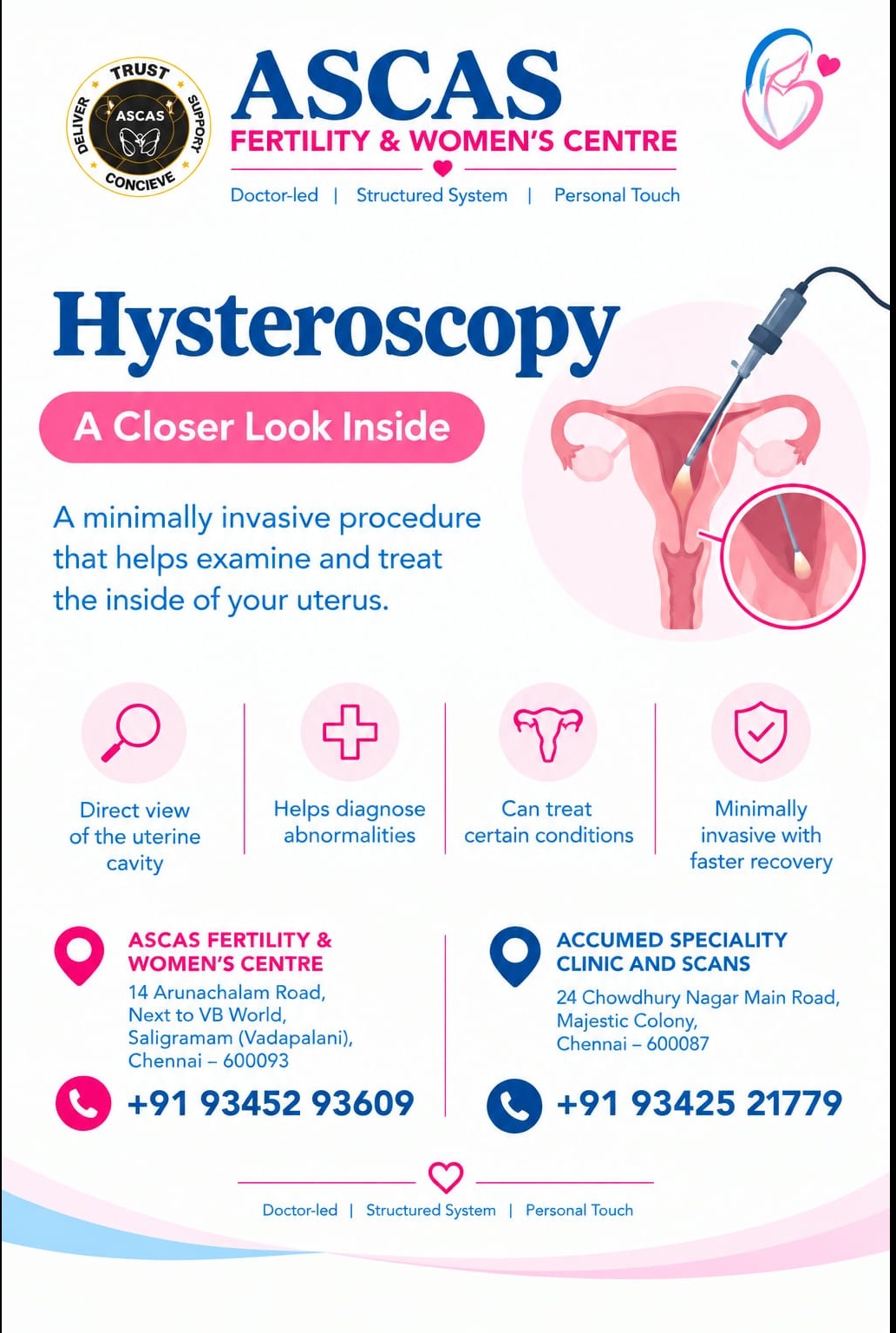
What Is Hysteroscopy?
Hysteroscopy is a minimally invasive procedure that allows a gynaecologist to examine the inside of the uterus using a thin, lighted instrument called a hysteroscope. The instrument is passed through the vagina and cervix, so no abdominal incision is usually needed.
Hysteroscopy can help diagnose certain causes of abnormal uterine bleeding, investigate abnormalities within the uterine cavity and treat selected conditions during the same procedure.
How Is Hysteroscopy Performed?
1.The procedure is planned according to the patient's symptoms, medical history and clinical findings.
2.Pre-procedure assessment: The gynaecologist reviews symptoms, medical history and any relevant scan reports.
Insertion of the hysteroscope: A thin instrument is gently passed through the cervix into the uterus.
3.Examination of the uterine cavity: The uterine lining and cavity are examined using a camera and light source.
4.Treatment, if required: Selected abnormalities may be treated during the procedure, depending on the findings and clinical suitability.
5.Recovery and follow-up: The patient receives aftercare instructions and follow-up recommendations.
Hysteroscopy may be performed as an outpatient procedure or in an operating theatre, depending on the complexity of the procedure, the patient's needs and the type of anaesthesia required.
Why Is Hysteroscopy Performed?
Hysteroscopy may be recommended to investigate or treat:
*Endometrial polyps: Growths arising from the uterine lining.
*Submucosal fibroids: Fibroids that project into the uterine cavity.
*Intrauterine adhesions: Scar tissue inside the uterus.
*Abnormal uterine bleeding: When assessment of the uterine cavity is indicated.
*Suspected uterine cavity abnormalities: Findings that require direct visual examination.
*Selected fertility-related concerns: When an intrauterine abnormality is suspected.
How Can Hysteroscopy Help in Fertility Care?
The shape and condition of the uterine cavity can be important in reproductive health. When a polyp, submucosal fibroid, adhesion or other abnormality is identified, hysteroscopy may help the specialist assess it and determine whether treatment is appropriate.
For selected patients, treating a uterine cavity abnormality may improve the conditions for conception or pregnancy. However, hysteroscopy is not required for every patient experiencing infertility, and the benefit depends on the specific finding and individual clinical circumstances.
Who May Benefit from Hysteroscopy?
A gynaecologist may recommend hysteroscopy for patients who have:
*Persistent or unexplained abnormal uterine bleeding.
*Suspected polyps, fibroids or adhesions within the uterine cavity.
*An abnormal finding on ultrasound or other uterine imaging.
Selected fertility concerns requiring further evaluation.
*A need for direct examination of the uterine cavity.
*The decision is based on the patient's symptoms, examination, imaging results and treatment goals.
Benefits of Hysteroscopy
*Direct visualisation: Allows the gynaecologist to examine the uterine cavity.
*Targeted treatment: Certain abnormalities can be treated during the same procedure.
*No abdominal incision in most cases: The instrument is introduced through the natural passage.
*Individualised care: Helps guide further treatment according to the findings.
Are there any risks?
Hysteroscopy is generally safe when appropriately indicated, but potential risks include cramping, bleeding, infection, injury to the uterus or cervix, and complications related to the fluid used during the procedure or anaesthesia. Recovery time varies depending on the procedure performed.
Your gynaecologist will explain the expected benefits, possible risks and suitable alternatives before treatment.
The Role of Your Gynaecologist
At ASCAS Fertility & Women’s Centre, evaluation and treatment are planned according to each patient's reproductive health needs.
Dr. Aishwarya Parthasarathy
Consultant Fertility Specialist & Gynaecologist
The specialist reviews symptoms and scan findings, determines whether hysteroscopy is appropriate, discusses treatment options and guides the patient through recovery and follow-up. The clinical team provides preparation instructions and support throughout the care journey.
Consult Our Centres
ASCAS Fertility & Women’s Centre
14 Arunachalam Road, Next to VB World, Saligramam (Vadapalani), Chennai – 600093
Phone: +91 93452 93609
Accumed Speciality Clinic & Scans
24 Chowdhury Nagar Main Road, Majestic Colony, Chennai – 600087
Phone: +91 93425 21779
ASCAS Fertility & Women’s Centre
Doctor-led • Structured System • Personal Touch
Keywords