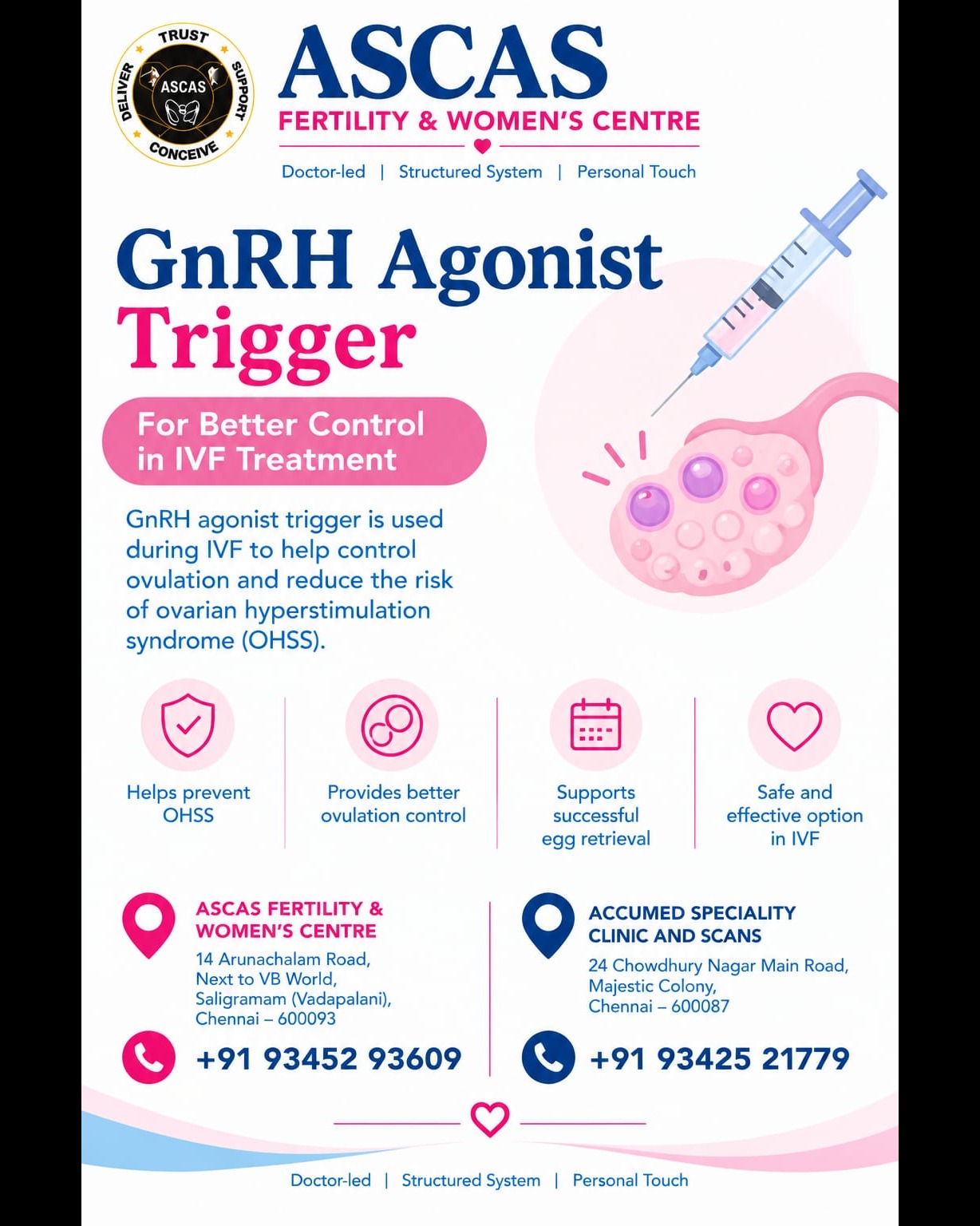
🌸 GnRH Agonist Trigger – Advanced Ovulation Triggering in IVF
What Is a GnRH Agonist Trigger?
A GnRH (Gonadotropin-Releasing Hormone) agonist trigger is a medication used during IVF treatment to stimulate the final maturation of eggs before egg retrieval. It works by stimulating the body's natural release of luteinising hormone (LH) and follicle-stimulating hormone (FSH).
In appropriately selected patients, this approach can help reduce the risk of ovarian hyperstimulation syndrome (OHSS), a potential complication of fertility treatment.
How Does It Work?
During an IVF cycle, the fertility team monitors the growth and development of ovarian follicles through ultrasound scans and, when indicated, hormone tests.
The treatment generally involves:
*Ovarian stimulation: Medications encourage multiple follicles to develop.
*Follicle monitoring: The response is assessed through scans and hormone measurements.
*Trigger medication: A GnRH agonist is administered at the prescribed time to support final egg maturation.
*Egg retrieval: The eggs are collected at the planned time, usually around 34–36 hours after the trigger, according to the clinic's protocol.
Why Is a GnRH Agonist Trigger Used?
A GnRH agonist trigger may be considered to:
*Support final egg maturation before egg retrieval.
*Reduce the risk of moderate-to-severe OHSS in appropriately selected patients.
*Help personalise the IVF treatment plan according to the patient's ovarian response.
*Support a carefully planned egg retrieval and embryo-management strategy.
*For patients at increased risk of OHSS, the fertility specialist may recommend freezing suitable embryos for later transfer rather than proceeding with a fresh embryo transfer. The decision depends on the patient's individual circumstances.
Who May Benefit?
A GnRH agonist trigger may be considered for patients undergoing IVF who have an increased risk of OHSS, including some patients with:
*Polycystic ovary syndrome (PCOS).
*A high ovarian response during stimulation.
*A large number of developing follicles.
*Other clinical or hormonal features associated with increased OHSS risk.
Important: This trigger is not suitable for every IVF cycle. The fertility specialist determines the appropriate medication and timing based on the treatment protocol and individual response.
The Role of Your Fertility Specialist
At ASCAS Fertility & Women’s Centre, fertility care involves individualised treatment planning, careful monitoring and appropriate medication selection.
Dr. Aishwarya Parthasarathy
Consultant Fertility Specialist & Gynaecologist
The fertility specialist evaluates ovarian response, assesses the risk of OHSS, selects the appropriate trigger and plans the timing of egg retrieval. The clinical team also guides patients through monitoring and follow-up.
Frequently Asked Questions
1. Does a GnRH agonist trigger guarantee mature eggs?
No. It supports final egg maturation, but the number and maturity of eggs retrieved vary between patients.
2. Does it completely prevent OHSS?
No. It can significantly reduce the risk of OHSS in appropriately selected patients, but it does not eliminate every risk.
3. Can embryo transfer happen in the same cycle?
Sometimes, but the decision depends on the patient's risk profile and treatment plan. A freeze-all approach may be recommended for patients at increased risk of OHSS.
4. When is egg retrieval performed after the trigger?
Egg retrieval is commonly scheduled approximately 34–36 hours after the trigger, according to the clinic's protocol. Patients should follow their fertility team's exact instructions.
Consult Our Fertility Team
ASCAS Fertility & Women’s Centre
📍 14 Arunachalam Road, Next to VB World, Saligramam (Vadapalani), Chennai – 600093
📞 +91 93452 93609
Accumed Speciality Clinic & Scans
📍 24 Chowdhury Nagar Main Road, Majestic Colony, Chennai – 600087
📞 +91 93425 21779
ASCAS Fertility & Women’s Centre
Doctor-led • Structured System • Personal Touch
Keywords